How Rent to Own Appliances Work and What to Know Before You Buy
A broken refrigerator or worn-out washer rarely waits for a perfect budget moment. When an appliance fails, the need is immediate, but the cost can be hard to handle all at once. That is where rent-to-own appliances enter the picture.
Rent-to-own can be useful for households that need an appliance now and prefer smaller payments over a large upfront purchase. It can also appeal to people with limited credit options, temporary housing plans, or a short-term need. Still, the convenience comes with trade-offs. The final cost may be much higher than buying the same appliance outright.
This guide explains how rent-to-own works, what the payment terms usually look like, how it compares with traditional buying, and how to choose a reputable company before signing an agreement.

What rent-to-own appliances mean
Rent-to-own is an agreement that lets a customer take home an appliance and make scheduled payments over time. The appliance might be a refrigerator, washer, dryer, stove, dishwasher, freezer, or microwave. If the customer completes all required payments, ownership transfers to them.
In simple terms, rent-to-own blends renting and buying. During the agreement, the company still owns the appliance. The customer pays to use it. If they finish the payment plan, they own it.
That structure creates three common outcomes:
The customer completes the agreement and keeps the appliance.
The customer returns the appliance before ownership and stops future payments, depending on the contract.
The customer uses an early purchase option to pay off the item sooner, often for less than the total scheduled cost.
The biggest benefit is access. Rent-to-own companies often do not require a large down payment or traditional credit approval. Many agreements focus on income, identity verification, payment method, and housing information rather than a standard credit score.
For someone who needs a working washer this week, that can be a meaningful advantage. It shifts the problem from “How do I pay $900 today?” to “Can I manage this weekly or monthly payment?”
Rent-to-own can also reduce commitment. If a household is testing a new living situation, renting temporarily, or unsure how long they will need a certain appliance, the ability to return the item may help. That flexibility is part of the appeal.
The trade-off is cost. Smaller payments can make the agreement feel manageable, but the total amount paid over the full term may exceed the retail price by a wide margin. That is why the most important number is not just the payment amount. It is the total cost to own.
How the rental process usually works
The process is usually straightforward, but each step matters. A rent-to-own agreement is still a contract, and the details shape the true cost.
You choose an appliance
The customer starts by selecting an appliance from a store or online catalog. Some companies carry new items, used items, or both. Used appliances may cost less each payment period, but they should still be clean, safe, and in good working order.
Before choosing, compare features the same way you would with a regular purchase. A basic top-freezer refrigerator and a large French-door refrigerator are not the same product, even if both are available with low weekly payments.
Look closely at:
Size and fit
Energy use
Capacity
Brand and model
New or previously rented condition
Delivery and installation availability
Warranty or service coverage during the rental term
Measurements matter. A refrigerator that does not fit through the doorway or a dryer that needs the wrong hookup can turn a convenient plan into a headache.
The company reviews your application
Rent-to-own companies typically ask for proof of identity, income, address, and a payment method. Requirements vary, but many providers promote flexible approval compared with credit cards or store financing.
Flexible does not mean automatic. A company may still deny an application if income cannot support the payment, if identity cannot be verified, or if the delivery address is outside its service area.
Some companies may check credit. Others may not. Ask this directly before applying, especially if you are trying to limit credit inquiries.
You agree to a payment schedule
Payments may be weekly, biweekly, semi-monthly, or monthly. Weekly payments can look smaller, but they are not always cheaper.
For example, a washer listed at $25 per week may seem easier than $100 per month. Yet there are more than four weeks in most months. Over a year, weekly billing adds up quickly.
Ask the company to show:
The payment amount
How often payments are due
The number of payments required to own the appliance
The total cost if every payment is made
The early purchase price
Any fees for delivery, installation, late payment, pickup, or reinstatement
A clear agreement should make these numbers easy to find. If the salesperson focuses only on the weekly price, slow down and ask for the full cost in writing.

The appliance is delivered or picked up
Many rent-to-own companies offer delivery. Some include it in the agreement, while others charge separately. Installation may also vary by appliance.
For a washer or dryer, ask who handles the hoses, vents, and hookups. For a refrigerator, ask whether the company connects the water line for an ice maker. For a stove, confirm whether gas or electric installation is available and whether a licensed installer is required.
Get delivery terms in writing. The agreement should explain what happens if the appliance arrives damaged, does not work, or cannot be installed because of space or hookup issues.
You make payments until you buy, return, or pay early
Once the agreement starts, the customer keeps the appliance while payments stay current. If payments stop, the company may contact the customer, charge fees, or request return of the appliance, based on the contract and state law.
Many agreements include an early purchase option. This can be valuable. If a tax refund, bonus, or savings goal makes it possible to pay off the appliance sooner, the customer may reduce the total cost.
Ask how the early payoff amount is calculated. Some companies offer a same-as-cash period for a limited time. Others use a discount after a certain number of payments. The exact rule matters.
What to check before signing an agreement
Rent-to-own can solve a short-term problem, but the agreement should fit the household budget and the appliance need. Before signing, review these points carefully.
The total cost to own
This is the number that shows what the appliance will cost if all scheduled payments are made. Compare it with the retail price of the same or similar appliance from a local store or online retailer.
A rent-to-own appliance may cost much more over time because the company builds in service, risk, delivery, and profit. That does not make every agreement bad, but it does mean the buyer should understand the premium being paid for flexibility.
A simple comparison helps:
Option | Upfront cost | Monthly commitment | Ownership | Common trade-off |
Cash purchase | Highest | None | Immediate | Requires savings now |
Credit card | Low to none | Varies | Immediate | Interest can grow if unpaid |
Store financing | Low to none | Fixed or promotional | Immediate | May require credit approval |
Rent-to-own | Often low | Fixed by agreement | After final payment | Total cost is often higher |
Fees and missed payment rules
A low payment can become expensive if fees pile up. Review the agreement for late fees, processing fees, delivery fees, reinstatement fees, damage fees, and pickup fees.
Also ask what happens after a missed payment. Is there a grace period? Can the agreement be reinstated? Does the customer lose prior payments if the appliance is returned? The answer should be clear before the appliance comes home.
Repair and replacement coverage
One reason people like rent-to-own is that service may be included while the item is still under agreement. If the washer stops draining or the refrigerator stops cooling, the company may repair or replace it.
Do not assume coverage is complete. Ask:
Who pays for repairs during the rental term?
How fast does service usually happen?
Is a loaner appliance available?
What counts as customer damage?
Are pests, misuse, or improper installation excluded?
A repair policy is only helpful if it is written clearly and the company honors it.
Appliance condition
If the appliance is used, inspect it before accepting delivery. Check for dents, rust, odors, missing racks, cracked bins, strange noises, and worn seals.
For any appliance, look for the model number. This helps you compare retail prices, read reviews, and check energy information. A rent-to-own company should not object to a customer knowing the exact model.

Fit with the monthly budget
The payment should be comfortable, not just possible. Appliances are essential, so missed payments can create stress fast.
Before signing, compare the payment with regular bills such as rent, utilities, groceries, insurance, gas, and childcare. If the payment would only work in a perfect month, the agreement may be too tight.
A good rule of thumb is to review the contract as if one unexpected expense has already happened. If a car repair or medical bill would make the appliance payment impossible, consider a cheaper model, used appliance store, local resale option, or delayed purchase.
How rent-to-own compares with buying
Traditional buying and rent-to-own meet different needs. Neither is always best. The right choice depends on cash available, credit access, urgency, and how long the appliance will be needed.
Buying with cash is usually the cheapest route over time. There are no ongoing payments and no rental premium. The downside is the upfront price. For major appliances, that can be hard to manage on short notice.
Store financing can make a new appliance easier to afford. Some retailers offer promotional periods, such as deferred interest or low monthly payments. These deals can be useful, but they often require credit approval. Deferred interest plans can also become costly if the balance is not paid within the promotional period.
Credit cards offer speed and flexibility. They may also include purchase protections, depending on the card. The risk is interest. If the balance carries month to month, the cost can climb.
Used appliance stores, local marketplaces, and scratch-and-dent sections can offer lower prices. The trade-off is limited selection, shorter warranties, and more responsibility for pickup, delivery, and repairs.
Rent-to-own stands out in a few situations:
The appliance is needed immediately.
Cash savings are limited.
Credit approval is difficult.
Short-term flexibility matters.
Service during the rental term has real value.
It may be a poor fit when the customer can buy outright, qualifies for low-cost financing, or plans to keep the appliance for many years and wants the lowest total cost.
The key question is simple: Are the convenience and flexibility worth the extra total cost?
If the answer is yes, rent-to-own may make sense. If the answer is no, another buying path may be better.
How to find a reputable rent-to-own company
A reputable company makes the agreement easy to understand before asking for a signature. It answers questions directly, puts terms in writing, and treats service issues seriously.
Start with the basics. Search for companies that serve your area and compare more than one. Nationwide chains may offer broad selection and established policies. Local companies may offer more personal service or used appliance options. Both can be good choices if the terms are fair and clear.
Look for these signs of a trustworthy provider.
Clear written pricing
The company should show the cash price, payment amount, payment frequency, total cost to own, and early purchase option. If those numbers are hard to get, choose another provider.
Plain contract terms
The agreement should explain late payments, returns, repairs, ownership transfer, and fees in language that makes sense. Do not rely on verbal promises.
Reasonable service policies
Ask how repairs are handled and how quickly service calls are scheduled. A company that rents essential appliances should have a realistic plan when something breaks.
Good customer feedback
Read reviews from multiple sources when possible. Look for patterns, not one angry comment or one glowing review. Pay attention to complaints about surprise fees, aggressive collection behavior, poor repairs, or unclear payoff terms.
No pressure tactics
A company should give customers time to read the agreement. Be careful if a salesperson pushes urgency, avoids answering questions, or says the contract details are “standard” without explaining them.
Clean and tested appliances
Whether new or used, appliances should be in working order and safe to use. Ask whether used appliances are tested, cleaned, and inspected before delivery.
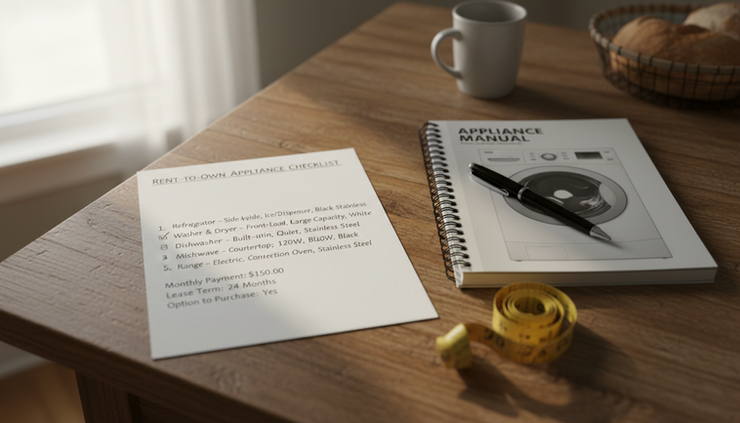
Before signing, use this quick checklist:
Compare the total cost with the retail price.
Confirm the exact model and condition.
Ask whether the appliance is new or used.
Review all fees.
Understand missed payment rules.
Get repair coverage in writing.
Ask about early payoff.
Keep a copy of the agreement.
The takeaway before you decide
Rent-to-own appliances can be a practical option when a refrigerator, washer, dryer, or stove is needed right away and paying the full price upfront is not realistic. The main benefits are fast access, flexible approval, predictable payments, and the option to return or own the appliance depending on the agreement.
The main drawback is cost. A small weekly or monthly payment can lead to a much higher total price over time. That makes comparison shopping essential.
Before agreeing to any plan, focus on four numbers: the payment amount, the payment schedule, the total cost to own, and the early payoff price. Then look closely at fees, repairs, appliance condition, and return rules.
A good rent-to-own agreement should feel clear before the appliance arrives, not confusing after the first bill. If the terms make sense, the payment fits the budget, and the company has a solid reputation, rent-to-own can fill an important gap. If the total cost feels too high or the contract is unclear, keep shopping. The best appliance deal is one that solves the immediate problem without creating a bigger one later.


Comments